Posts tagged cultural worlds


Nate
:
 Every man a king
Nate
:
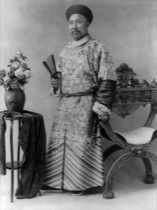
[T]here are railroad kings, copper kings, tobacco kings, etc. It is, however, manifestly improper and incongruous that the people should possess a higher title than their President, who is the head of the nation. To make it even, I would suggest that the title “President” be changed to “Emperor,” for the following reasons: First, it would not only do away with the impropriety of the chief magistrate of the nation assuming a name below that of some of his people, but it would place him on a level with the highest ruler of any nation on the face of the earth. I have often heard the remark that the President of the United States is no more than a common citizen, elected for four years, and that on the expiration of his term he reverts to his former humble status of a private citizen; that he has nothing in common with the dignified majesty of an Emperor; but were the highest official of the United States to be in future officially known as Emperor, all these depreciatory remarks would fall to the ground. There is no reason whatever why he should not be so styled, as, by virtue of his high office, he possesses almost as much power as the most aristocratic ruler of any nation. Secondly, it would clearly demonstrate the sovereign power of the people; a people who could make and unmake an Emperor, would certainly be highly respected. Thirdly, the United States sends ambassadors to Germany, Austria, Russia, etc. According to international law, ambassadors have what is called the representative character, that is, they represent their sovereign by whom they are delegated, and are entitled to the same honors to which their constituent would be entitled were he personally present. In a Republic where the head of the State is only a citizen and the sovereign is the people, it is only by a stretch of imagination that its ambassador can be said to represent the person of his sovereign. Now it would be much more in consonance with the dignified character of an American ambassador to be the representative of an Emperor than of a simple President. The name of Emperor may be distasteful to some, but may not a new meaning be given to it?


Nate
: Two worlds, one club
Nate
: Decisive moments
Nate
:
There’s a wonderful article in the new Atlantic by Mark Bowden called “The Hardest Job in Football.” That hardest job is being the director of a television broadcast of a game. Bowden focuses on a man named Bob Fishman, whom he believes to be the best at this job, as Fishman sits in a control room before a bank of TV screens. Each screen shows what one of the many cameras scattered around the stadium is seeing, and Fishman’s job during the game is to scan that bank of screens and decide what the guy watching the game at home on his TV should be seeing at any given moment. It’s fascinating to think what cognitive skills make someone good at this. You have to be able to take in the import of an image in a millisecond — a moving image! — and, in a few milliseconds more, evaluate it in relation to all the other images you’re viewing. But can only do this well not by thinking of the intrinsic visual interest of a particular image, but rather by having in mind a narrative structure, a sense of what the game is about — and not just what it’s about in some general sense, but what it’s about at this particular moment. And that will vary according to whether a team is ahead or behind; whether they are deep in their own territory or deep in the opponents’; whether it’s near the beginning or the end of the game; even what stories have been in the news leading up to the game. The director’s narrative sense, then, needs to govern his visual sense. Fascinating stuff.
Nate
:And yet, city life isn’t easy. The same London cafes that stimulated Ben Franklin also helped spread cholera; Picasso eventually bought an estate in quiet Provence. While the modern city might be a haven for playwrights, poets, and physicists, it’s also a deeply unnatural and overwhelming place.
Now scientists have begun to examine how the city affects the brain, and the results are chastening. Just being in an urban environment, they have found, impairs our basic mental processes. After spending a few minutes on a crowded city street, the brain is less able to hold things in memory, and suffers from reduced self-control. While it’s long been recognized that city life is exhausting—that’s why Picasso left Paris—this new research suggests that cities actually dull our thinking, sometimes dramatically so.
“The mind is a limited machine,“says Marc Berman, a psychologist at the University of Michigan and lead author of a new study that measured the cognitive deficits caused by a short urban walk. “And we’re beginning to understand the different ways that a city can exceed those limitations.”
One of the main forces at work is a stark lack of nature, which is surprisingly beneficial for the brain. Studies have demonstrated, for instance, that hospital patients recover more quickly when they can see trees from their windows, and that women living in public housing are better able to focus when their apartment overlooks a grassy courtyard. Even these fleeting glimpses of nature improve brain performance, it seems, because they provide a mental break from the urban roil.
Six continents’ worth of static
Nate
:When all you want is Friends (or even its Arabic equivalent), prepare to weed through Italian soaps, Iranian talk shows, the Pentagon channel, Egyptian poetry, Russian porn, Mecca 24/7, Italian porn, state-run news, Kurdish divas, soccer, fútbol, American rap on Arab MTV, Bollywood revels, false prophets from Holland, German business commentary. When you finally come to Courteney Cox and Jennifer Aniston, they’re dubbed in Japanese.
I suppose the price you pay for living in a country that doesn’t produce too much TV for its own good is that you’re forced to learn about the rest of the world. This learning shouldn’t be confused with CIA World Factbook-learning. It’s more like what you’d get from a good intercontinental love affair. At the very least, watching the satellite means being subjected to the fact that this planet is crowded and teeming with desires for every kind of stardom. Amidst them all, our little languages and preferences are the tiniest of snowflakes falling in six continents’ worth of static.
The new old cartography
Nate
:Geography | How the new cartography is like mapmaking in the Middle Ages: Today’s maps are “geographically accurate beyond the dreams of a medieval mind,” yet they’re still, perhaps more than ever, vehicles for representing the world’s geography as the mapmaker idiosyncratically interprets it — never mind getting from point A to point B. [Boston Globe]
Rich objects
Nate
: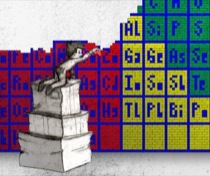
Science is fueled by passion, a passion that is often attached to the world of objects much as the artist is attached to his paints, the poet to her words. From my first days at the Massachusetts Institute of Technology in 1976, I saw this passion for objects everywhere. My students and colleagues told how they were drawn into science by the physics of sand castles, by playing with soap bubbles, by the mesmerizing power of a crystal radio.
Since this was the early days of computer culture, there was also talk of new objects. Some people identified with their computers, experiencing these machines as extensions of themselves. For them, computers were useful for thinking about larger questions, questions of determinism and free will, of mind and mechanism ...
Objects don’t nudge every child toward science, but for some, a rich object world is the best way to give science a chance. Given the opportunity, children will make intimate connections, connections they must construct on their own ...
If we attend to young scientists’ romance with objects, we are encouraged to make children comfortable with the idea that falling in love with things is part of what we expect of them. We are encouraged to introduce the periodic table as poetry and LEGOs as a form of art.

Nate
:When libraries shine
Nate
:The Boston Public Library is no different. New library cards are up 32.7 percent from July to November of 2008, compared with the same period in 2007. Visits are up 13 percent, from 1.4 million visits to 1.6 million. Checkouts of books, CDs, and DVDs are up 7.2 percent overall over the last fiscal year. More telling is that checkouts have soared between 27 percent and 37 percent at the Egleston Square, Fields Corner, Jamaica Plain, and Orient Heights branches.
New BPL president Amy Ryan said a baby story program at the Copley library has grown from fluctuating between 60 and 80 families to well over 100. Monthly visits to a free Internet homework tutoring service have doubled from 300 to 600. She said anecdotal reports indicate a spike in people using branch libraries to research new careers or returning to school. This is despite the BPL probably facing cuts, too.
“Libraries are unfortunately used to this,” Ryan said. “But the essential role of the library cannot be duplicated in anybody’s home, when you consider the combination of manuals, books, and librarian expertise,” Ryan said. “In down economic times, families aren’t going out to spend a lot of money on books and movies. This is when the branches can shine as a community gathering place and at a time when people are seeking answers to life improvement.”
Crosstown crosswords
Nate
: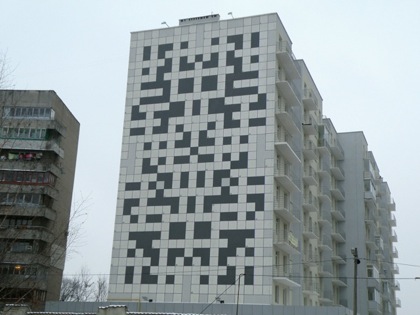
People of Lvov city in Ukraine decided to add another attraction for the visitors of their city. According to the artistic project it was decided to place a giant 100 feet (30 meters) tall at the wall of the one of the multi-stored residential houses.
There is one interesting detail about the design of the puzzle. It looks like an empty puzzle during the day-light, but at night when special lights are on the words in the puzzle become visible with a lightly-glowing fluorescent color.
The questions for this crossword puzzle are located in different point of interests of the city, like monuments, theaters, fountains etc. So people while walking around the city can try to answer the questions and writing down the answers. When the night comes to the city they can meet at this house and check their degree of intelligence.
Nate
:Nate
:When a modern Japanese family sits round the supper table eathing their bowls of Japanese-grown rice, they are not simply indulging a gastronomic preference for short-grain and slightly sticky Japonica rice over long-grain Indica rice from Thailand. They are eating and absorbing a tradition—in the sense of an invented and reinvented past. While the television beside the dining table pours out a stream of images of the here-and-now, of an urbanized, capitalist, and thoroughly internationalized Japan, each mouthful of rice offers communion with eternal and untainted Japanese values, with a rural world of simplicity and purity, inhabited by peasants tending tiny green farms in harmony with nature and ruled over by the emperor, descendant of the Sun Goddess, who plants and harvests rice himself each year in a special sacred plot. Simple peasant rice farmers are as marginal in contemporary Japan as hand-spinners are in India, but the small rice farm, like the swadeshi [homespun-style cloth] industry, lives on as a powerful symbol.

Nate
:The Amish (a quaint static ripple whose way of life will never uncover the simplest new technological fix for the unfolding hazards of a dynamic universe) have long recognized that material culture embodies weird inspirations, challenging us, as eventual consumers, not with ‘copy what I do’, but a far, far more subversive ‘try me.’
—Timothy Taylor, "Culture," response to Edge.org's 2009 Annual Question, "What will change everything?"


Nate
:Africa and missionaries, pt. 1
Nate
:Now a confirmed atheist, I’ve become convinced of the enormous contribution that Christian evangelism makes in Africa: sharply distinct from the work of secular NGOs, government projects and international aid efforts. These alone will not do. Education and training alone will not do. In Africa Christianity changes people’s hearts. It brings a spiritual transformation. The rebirth is real. The change is good.
I used to avoid this truth by applauding - as you can - the practical work of mission churches in Africa. It’s a pity, I would say, that salvation is part of the package, but Christians black and white, working in Africa, do heal the sick, do teach people to read and write; and only the severest kind of secularist could see a mission hospital or school and say the world would be better without it. I would allow that if faith was needed to motivate missionaries to help, then, fine: but what counted was the help, not the faith.
But this doesn’t fit the facts. Faith does more than support the missionary; it is also transferred to his flock. This is the effect that matters so immensely, and which I cannot help observing.
Africa and missionaries, pt. 2
Nate
:Majestic in a green chasuble, Father Ibemere delivered his homily strolling up and down the aisle. When it was time to distribute the eucharist, he bent down to give communion to a man he knew was too ill to stand.
After the Mass, however, one member of the congregation, Virginia Ballard, gestured toward the Nigerian priest and confided in Father Venters, “I can’t understand what he said, but he’s a sweet young man.”
Mrs. Ballard went on to praise Father Ibemere’s knowledge of the Bible, his capacity to remember the names of congregants, his willingness to teach the Americans about his home in Nigeria. “He is a holy man,” she concluded, “and we are honored to have him.”

Nate
: